

Pay to Play Marketing for Small Businesses: Why It Feels Necessary and Falls Short

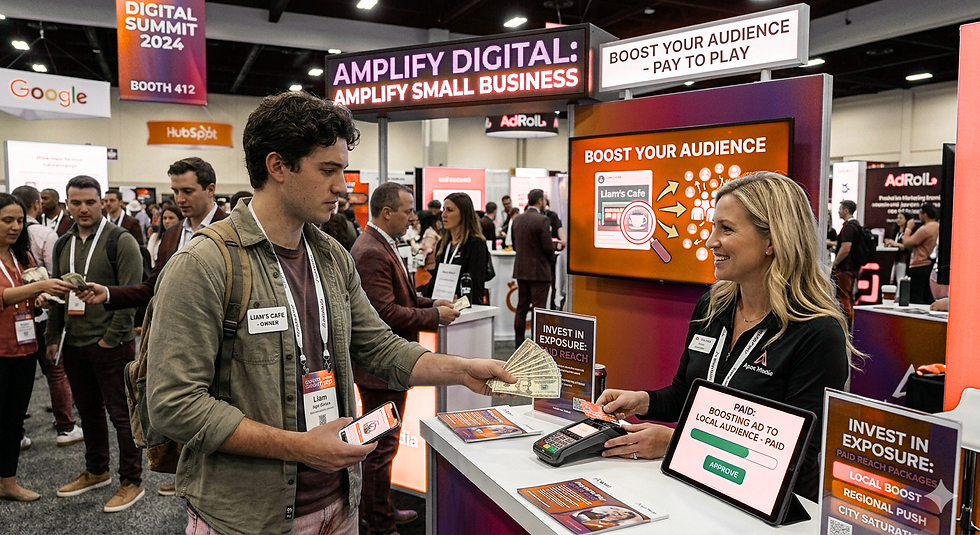
If you feel like your business only gets visibility when you are spending money, you are not alone. This is the reality many small business owners face with pay to play marketing.
Your content performs better when you boost it. Your reach increases when you run ads. And the moment you stop spending, everything slows down.
It creates the impression that growth depends on your budget.
In this post, we are breaking down how pay to play marketing works, why it feels effective at first, and why it often falls short for small businesses trying to build something sustainable.
Because more spending is not the solution. Better alignment is.
What Is Pay to Play Marketing?
Pay to play marketing is a paid marketing strategy for small business where visibility is driven by ad spend rather than organic reach.
Businesses pay for exposure through:
Ads
Boosted posts
Sponsored placements
This allows content to reach a larger audience—but only while budget is applied.
Why Pay to Play Marketing Matters for Small Businesses

Pay to play marketing is built on a simple reality:
The more money you spend, the more visibility you get.
Platforms like Instagram and Facebook prioritize paid distribution, while tools like Google Ads make it easy to increase reach on demand.
As organic reach continues to decline across platforms, this model becomes more pronounced.
For larger companies, this scales.
For small businesses, it creates a disadvantage.
You are competing in a system where visibility is influenced by spending power—not strategy, not clarity, and not connection.
What Pay to Play Marketing Actually Does
Pay to play marketing does one thing well:
It increases exposure.
You pay to put your content in front of more people through ads, boosted posts, or sponsored placements.
But that visibility is conditional.
It only exists while you are paying for it.
Which means you are not building momentum—you are maintaining access.
Why Pay to Play Marketing Feels Like It Works

Paid visibility creates immediate movement. That is what makes it convincing.
You see higher reach, more clicks, and increased activity.
But this mirrors a common issue in content strategy—confusing activity with effectiveness.
In my previous post, How to Evaluate Social Media Content Performance and Improve Engagement for Small Businesses, I break down how metrics like likes and reach can create the illusion of success without leading to real engagement or inquiries.
The same principle applies here.
A pattern I see often in working with small businesses:
A business owner boosts a post, sees a spike in reach, and assumes the content is working. They continue investing in similar posts, but inquiries remain inconsistent or nonexistent.
The issue is not visibility.
It is that visibility is being mistaken for alignment.
Why Pay to Play Marketing Fails Small Businesses

Visibility Is Tied to Budget, Not Strategy
When reach is driven by spend, growth becomes limited by what you can afford—not how well your marketing is working.
It Amplifies Weak Messaging
Paid marketing does not improve unclear positioning.
It exposes it.
If your content is not connecting, ads will not fix that—they will increase how many people ignore it.
It Attracts Attention Without Quality
More visibility does not mean better visibility.
Without alignment, you attract:
People who are not a fit
Traffic that does not convert
Interest that does not turn into clients
This is where businesses feel active but do not see results.
Where Small Business Owners Misinterpret Results
The mistake is not using paid marketing. It is how success is measured.
If your reach increases but your inquiries do not, that is not progress.
It is a signal.
Pay to play marketing often masks this by producing numbers that look positive but do not translate into outcomes.
Common Pay to Play Marketing Mistakes
Relying on ads without a strong content foundation
Boosting content that has not proven to resonate
Trying to compete on visibility instead of clarity
Using paid marketing as a primary strategy instead of a support tool
Each of these leads back to the same issue: misalignment.
How to Evaluate Pay to Play Marketing Performance
You do not need complex data to assess your paid marketing strategy for small business.

If the answer is unclear or no, the issue is not reach.
It is strategy.
Pay to play marketing does not create demand. It distributes what already exists.
If you have not read it yet, How to Evaluate Social Media Content Performance and Improve Engagement for Small Businesses breaks this down further.
It shows you how to identify what is actually working, what is not, and how to refine your messaging so your marketing supports your business instead of just creating activity.
Pay to play marketing reinforces the idea that growth comes from spending more.
But for small businesses, that creates dependence instead of stability.
It ties visibility to budget, not effectiveness. And it often increases activity without improving outcomes.
Less is more here.
More visibility is not the goal. Better alignment is.

If your pay to play marketing strategy for small business is not producing results, there is a gap in your approach.
I offer focused 1:1 website clarity audits where we break down your content, messaging, and current performance—and give you clear, specific next steps to improve alignment and results.


Comments